
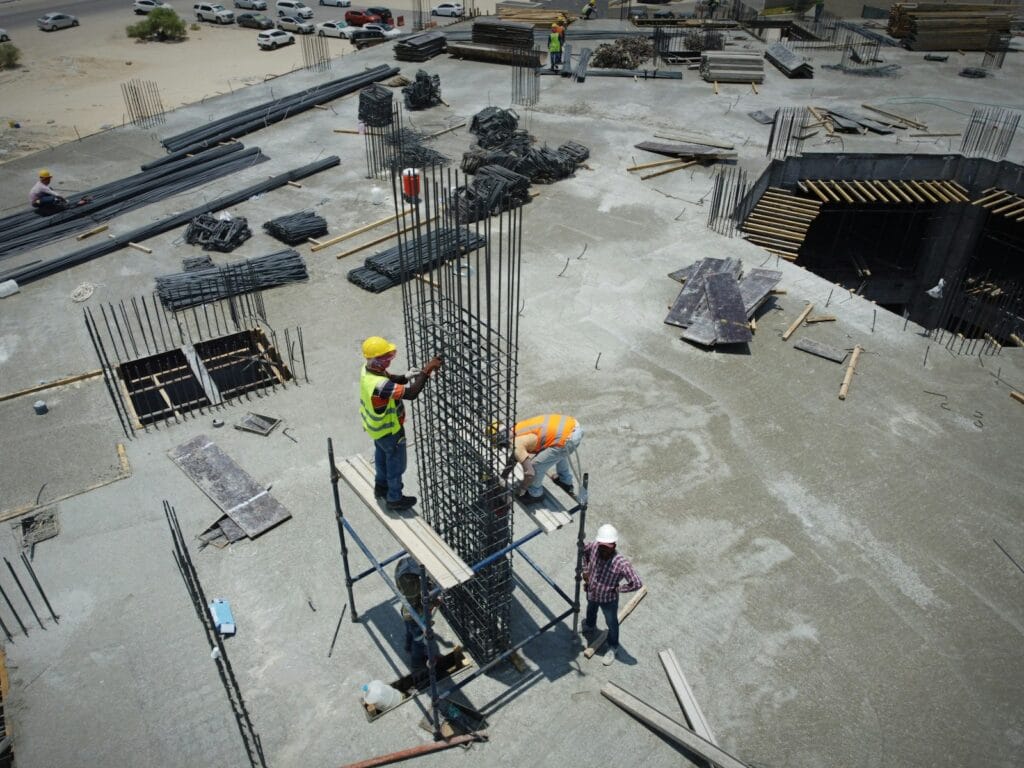
Site execution confidence is the difference between guessing under pressure and giving clear, practical direction on a construction site. Most civil engineers do not feel lost because they are weak in engineering; they feel lost because college and site life train two very different muscles.
In college, the question is usually clear. You are given a problem, a formula, a drawing, or a theory. On site, the question is rarely so neat. A worker asks for a decision. A drawing does not match the actual condition. Material reaches late. The contractor wants an approval. The client wants progress. Suddenly, the engineer has to connect drawings, sequence, quality, safety, communication, and time.
That is the real gap SiteReadySkills is built to solve: the gap between knowing civil engineering and executing civil engineering.
The First Shock: Site Work Is a System
A construction site is not a collection of isolated activities. Excavation affects footing. Footing affects column starter. Column alignment affects beam shuttering. Beam shuttering affects slab levels. Slab levels affect finishing. One missed check can travel forward and become a bigger problem later.
Fresh engineers often try to understand each activity separately. That helps, but only up to a point. Real confidence begins when you see the connections. Before giving an instruction, ask yourself: what has already happened, what is happening now, and what will this affect next?
Why Drawing Reading Feels Difficult on Site
Many students can read drawings in a classroom, but struggle when standing in front of actual columns, walls, beams, services, and workers. The drawing is clean. The site is noisy. The drawing has lines. The site has levels, offsets, materials, manpower, and pressure.
The practical way to improve is to read drawings with a sequence in mind. Do not only ask, “What is shown here?” Ask, “What work will be done from this drawing, who will do it, what checks are needed before starting, and what mistakes are likely?”
The Three Habits That Build Confidence
- Walk the site with a checklist. Random observation creates random learning. Checklists train your eye.
- Ask before the work starts. It is easier to prevent an error than to repair one after concrete, plaster, or finishing is complete.
- Document what you decide. A good site engineer does not rely only on memory. Photos, measurements, notes, and approvals protect the project.
Confidence Does Not Mean Knowing Everything
Many young engineers think confidence means never asking questions. In reality, the best engineers ask better questions. They know when to verify a drawing, when to check a specification, when to consult a senior, and when to stop unsafe or poor quality work.
Confidence is not guesswork. Confidence is a method.
How to Start This Week
Pick one live activity on site. It could be shuttering, reinforcement, blockwork, plaster, waterproofing, or finishing. Study the drawing. Visit the location. Ask what material is required, what manpower is needed, what quality checks apply, and what the next activity will be. Repeat this for one activity every day.
Within a few weeks, you will stop seeing the site as chaos. You will start seeing it as a connected execution system.
If you want a structured path, explore the SRS Site Execution Mastery Program or join the free SiteReadySkills webinar to understand how real construction execution is taught from the ground up.